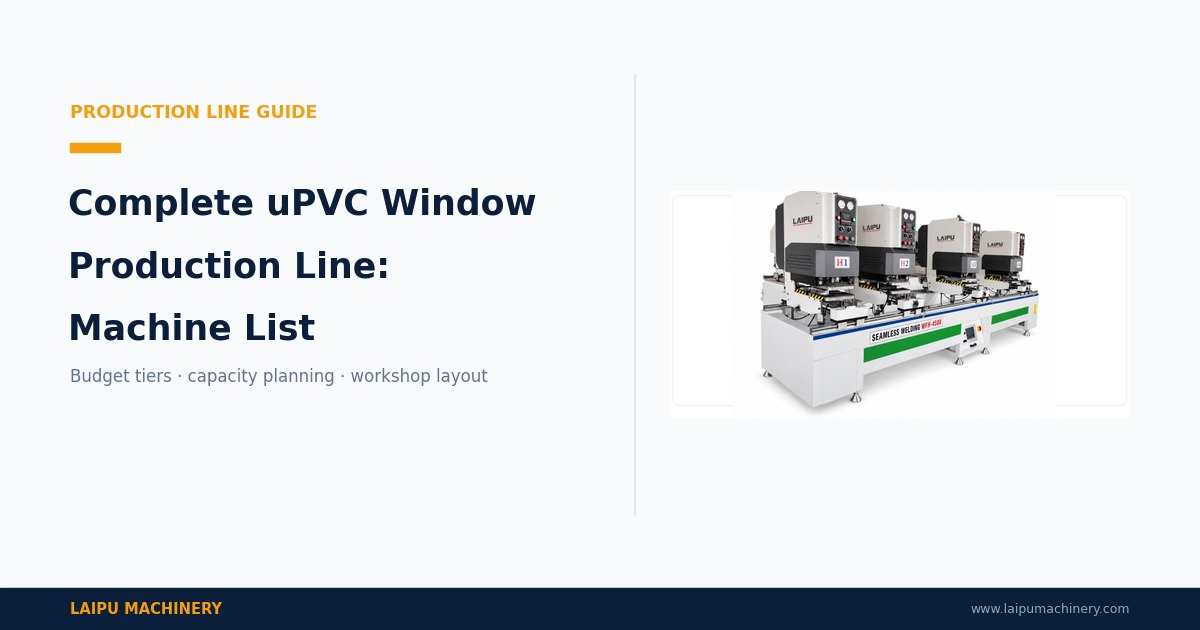
A uPVC window factory is one of the most accessible fabricating businesses to start: the process chain is short, the machines are affordable compared with aluminum, and demand for energy-efficient windows is growing in most markets. A complete line needs only six core machines. This guide lists them in process order, explains what each one does, and shows how to scale from a startup setup to a seamless-welding line.
The process flow
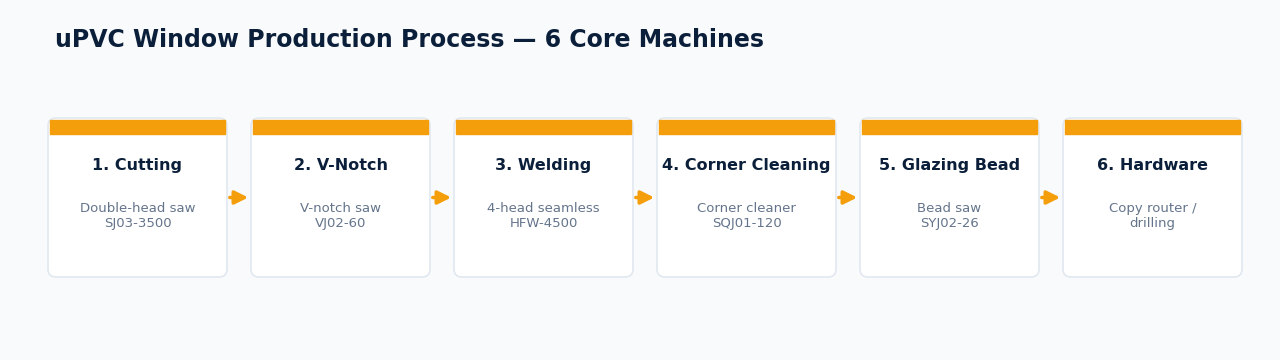
uPVC window production follows a fixed sequence: profiles are cut to length and angle, V-notches are milled at weld positions, frames and sashes are welded into rectangles, weld seams are cleaned, glazing beads are cut, and hardware holes are machined. Each step has one dedicated machine, and the whole line fits in roughly 150–250 m².
The six core machines
| # | Process step | Machine | What it does |
|---|---|---|---|
| 1 | Cutting | Double-head cutting saw (SJ03-3500) | Cuts two profile ends at 45°/90° simultaneously to length |
| 2 | V-notch | V-notch saw (VJ02-60) | Mills the 90° V-groove so welded corners close cleanly |
| 3 | Welding | 2-head or 4-head welding machine (HFW-4500 / SFW2-4500) | Heats and welds frame & sash corners into rectangles |
| 4 | Corner cleaning | Corner cleaning machine (SQJ01-120) | Machines weld beads off surfaces and outer corners |
| 5 | Glazing bead | Glazing bead cutting saw (SYJ02-26) | Cuts and chamfers bead profiles to size |
| 6 | Hardware | Copy router / drilling / drainage slot milling | Machines handle, lock and drainage openings |
Startup configuration (budget tier)
A startup line combines a two-head welding machine with standard cutting and cleaning equipment. Output is typically 40–60 windows per shift with 4–5 operators. This tier keeps capital low while covering the full process — nothing is outsourced.
- Double-head cutting saw — the accuracy anchor of the line
- Two-head welding machine (standard or single-side seamless)
- Manual-assisted corner cleaning
- V-notch saw + glazing bead saw
- One copy router or multi-head drill for hardware
Seamless welding upgrade (growth tier)
Standard welding leaves a visible seam line at the corner that must be painted or accepted as-is. Seamless welding machines (double-side or single-side) heat the profile so the corner fuses flat, producing a corner that looks like extruded material after light cleaning. The upgrade path: replace the two-head welder with a four-head seamless machine such as the HFW-4500 — weld quality rises, corner cleaning gets faster, and the window qualifies for premium markets where appearance decides the sale.
Capacity planning
- 40–60 windows/shift: 2-head welder, single cutting saw, 4–5 operators
- 80–120 windows/shift: 4-head welder (parallel corner welding halves cycle time), consider a second cutting saw
- Above 120 windows/shift: 4-head seamless line, automated corner cleaning, dedicated hardware machining cell
Workshop layout tips
- Lay machines out in process order (cut → notch → weld → clean → bead) so profiles flow one direction without crossing paths.
- Allow 1.5–2 m working space behind each saw for long profile handling.
- Welding machines need stable voltage; put them on their own circuit.
- Reserve a flat assembly table area near the welder for frame squaring before welding.
Machines for a uPVC line
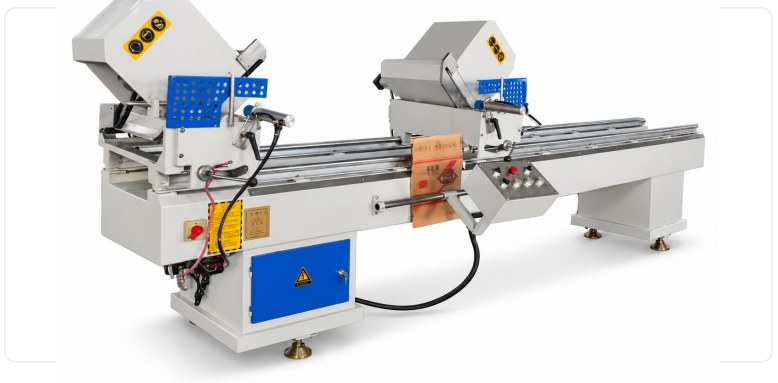
Double-Head Cutting Saw for Aluminum & uPVC Profiles
SJ03-3500
View machine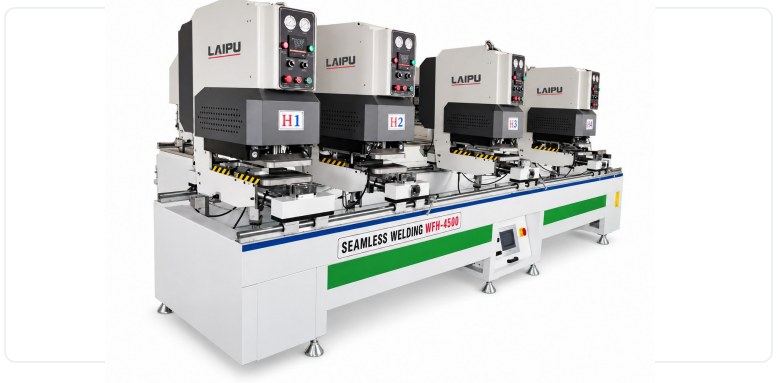
Four-Head Seamless Welding Machine
HFW-4500
View machine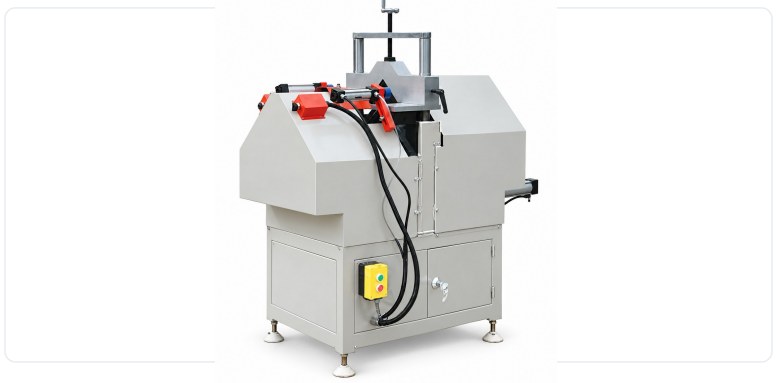
V-Notch Saw for uPVC Windows & Doors
VJ02-60
View machine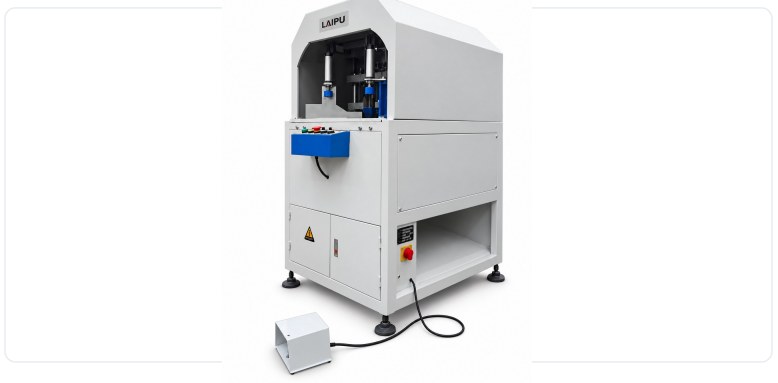
Corner Cleaning Machine for uPVC Windows & Doors
SQJ01-120
View machine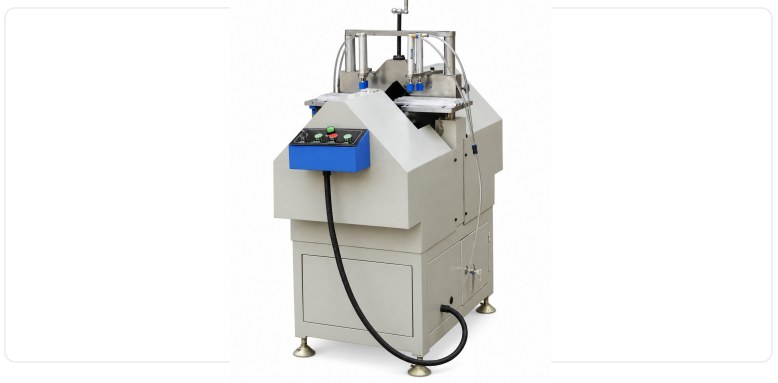
Glazing Bead Cutting Saw for uPVC Windows & Doors
SYJ02-26
View machineFrequently asked questions
How much space does a complete uPVC line need?
A startup six-machine line fits in about 150–200 m² including material storage and assembly area. A seamless-welding growth tier with better workflow needs 200–250 m².
Can I start with three machines and add the rest later?
Yes. Cutting saw, welding machine and corner cleaner are the true minimum — V-notch and glazing bead work can be subcontracted or done with manual tools at very low volume. Hardware machining is usually the fourth purchase.
Is seamless welding worth the extra cost?
If your target market is retail replacement windows where corner appearance is visible to homeowners, yes — seamless corners are a strong selling point. For budget construction projects, standard welding is usually accepted.
What do I need to tell a supplier to get an accurate quotation?
Your target capacity (windows per shift), the profile systems you will fabricate (brand and series), your workshop dimensions, and your local voltage/frequency. With these, a machine list and layout can be configured without guesswork.
Need a machine configuration for your factory?
Send your profile system and capacity target — reply within 24 hours on email or WhatsApp.